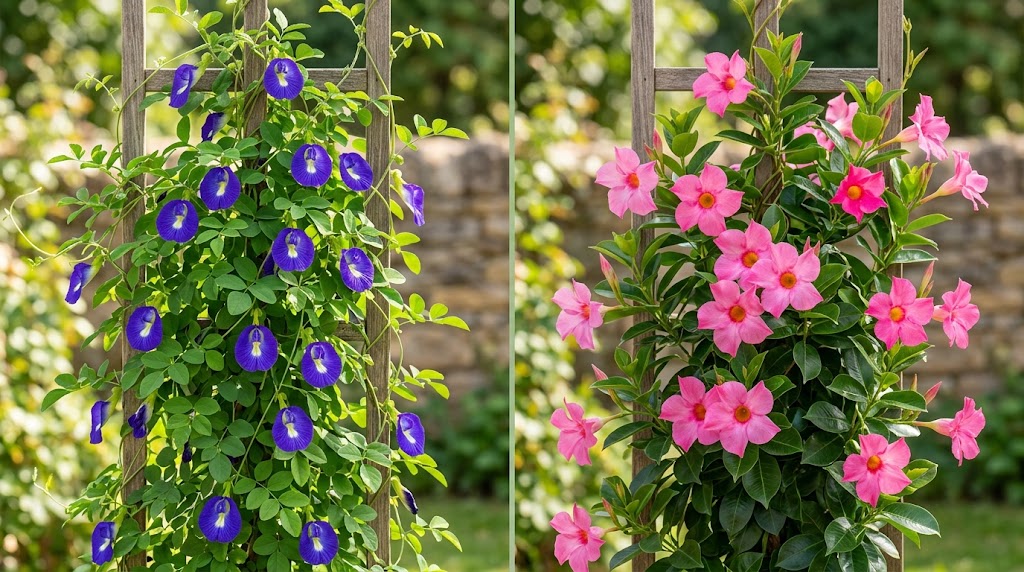

If you are looking for a beautiful climber for a home entrance, gate, balcony, pergola or garden arch, two attractive choices are Aparajita and Mandevilla. Both produce attractive flowers and can be trained over supports, but they are quite different when it comes to growth, uses, maintenance and safety.
🌿 1. Meet the Two Plants
💙 Aparajita — Clitoria ternatea

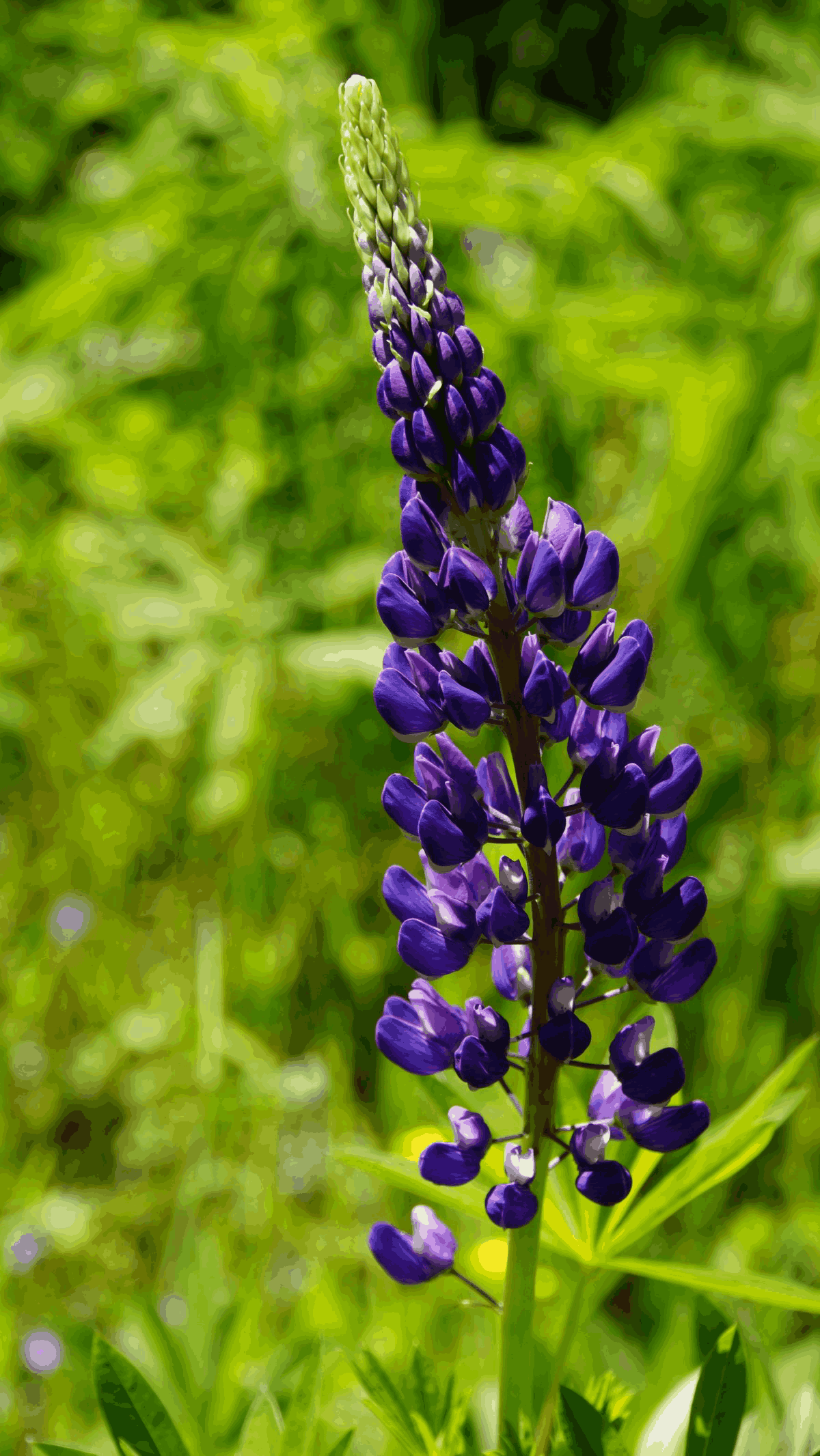
Aparajita, commonly called Butterfly Pea, is a vigorous tropical climbing plant. It is particularly popular in India because of its attractive blue flowers and its traditional association with Ayurveda and home gardens.
It is available in blue, white and other flower colours. Scientific literature also describes its flowers as being used as a natural food colour and in beverages.
🌸 Mandevilla — Mandevilla sanderi

Mandevilla is a tropical flowering vine belonging to the Apocynaceae (dogbane) family. It is especially valued as an ornamental plant for its large trumpet-shaped flowers and glossy foliage. It performs best with good sunlight and well-drained soil.
🌺 2. Aparajita vs Mandevilla — Quick Comparison
| Feature | 💙 Aparajita | 🌸 Mandevilla |
|---|---|---|
| Botanical name | Clitoria ternatea | Mandevilla sanderi |
| Type | Perennial climbing vine | Tropical climbing vine |
| Flower | Butterfly-shaped | Trumpet-shaped |
| Common colours | Blue, white, mauve | Pink, red, white |
| Growth | Fast | Moderate–fast |
| Suitable for arch | ⭐⭐⭐⭐⭐ | ⭐⭐⭐⭐⭐ |
| Sunlight | Full sun / partial shade | Bright sun |
| Maintenance | Low | Moderate |
| Pruning | Easy | Regular pruning beneficial |
| Traditional/food use | Flowers used as food/colouring | Ornamental only |
| Sap | No major irritating milky sap | Milky sap can irritate |
| Toxicity concern | Relatively low, but not completely risk-free | Greater caution required |
| Best feature | Fast coverage + useful flowers | Large, spectacular flowers |
💙 3. Benefits of Growing Aparajita
Aparajita has several advantages for an Indian home garden.
🌿 Fast-growing climber
It can quickly cover a trellis, fence or arch when provided with suitable support. Scientific literature reports that flowering can begin relatively early under suitable growing conditions.
🌸 Attractive flowers
The butterfly-shaped flowers are particularly attractive when the plant is trained over an entrance arch.
🦋 Garden value
Its flowers attract pollinating insects and give a natural, colourful appearance to the entrance.
🫖 Flowers have food applications
This is one of Aparajita’s major differences from Mandevilla.
Clitoria ternatea flowers are used in some cultures as an edible flower and as a natural blue colourant for beverages and foods.
🌱 Traditional medicinal importance
Aparajita has a long history of traditional use, including Ayurvedic applications. However, traditional use should not be confused with proven medical treatment; many reported health effects still require stronger human clinical evidence.
🌸 4. Benefits of Growing Mandevilla
Mandevilla has a different advantage: ornamental beauty.
🌺 Large showy flowers
Mandevilla produces striking trumpet-shaped flowers, making it particularly attractive around entrances and patios.
🌿 Glossy foliage
Its dark green glossy leaves provide an attractive background even when flowering is reduced.
🏡 Excellent for decorative arches
With a suitable trellis, wire frame or arch, Mandevilla can be trained into a very attractive entrance feature.
☀️ Good flowering in warm conditions
Mandevilla likes sunlight and well-drained soil. In warm tropical/subtropical conditions it can remain evergreen and flower for extended periods.
⚠️ 5. Toxicity and Safety — The Important Difference
This is where I would give Aparajita an advantage for a family garden.
💙 Aparajita toxicity
Aparajita is not a plant that should simply be described as completely “non-toxic.”
Research has investigated its flowers, leaves, roots and seeds, and laboratory/animal studies have generally found relatively low acute toxicity at tested oral doses. However, concentrated extracts can behave differently from the ordinary plant or flower consumed traditionally.
Therefore:
✔ Flowers have food uses
✔ Used traditionally in beverages and foods
✔ Generally considered a relatively low-risk garden plant when used appropriately
⚠ Do not consume large quantities or concentrated extracts without appropriate knowledge
⚠ Do not make medical claims based solely on laboratory studies
🌸 Mandevilla toxicity
Mandevilla deserves more caution.
The plant produces a milky sap/latex when its stems or leaves are damaged. The University of Florida’s gardening guidance specifically advises caution because this sap can irritate the skin and may be toxic if ingested.
A veterinary toxicology database also describes Mandevilla sanderi as weakly poisonous, noting potentially irritating substances in its milky sap.
Therefore:
⚠ Do not eat the plant
⚠ Avoid contact with the milky sap
⚠ Wear gloves when pruning
⚠ Wash hands after handling
⚠ Keep young children from chewing the plant
⚠ Take extra care if pets regularly chew garden plants
There is some inconsistency among pet-safety references regarding the severity of Mandevilla toxicity, so I would not market it as a pet-safe plant. The safest approach is to prevent pets from chewing it.
🏆 6. Which One Is Better for a Home Entrance Arch?
For your particular idea of creating a round arch at the main entrance, I would rank them like this:
🥇 Aparajita — Best overall for a home garden
Why?
- Fast-growing
- Easy to train
- Beautiful flowers
- Excellent for an arch
- Suitable for Indian conditions
- Flowers have traditional and food-related uses
- Lower toxicity concern than Mandevilla when grown normally
🥈 Mandevilla — Best for premium ornamental appearance
Choose Mandevilla if your priority is:
“I want my entrance to look like a professionally landscaped flowering entrance.”
Its large trumpet flowers and glossy leaves can create a very impressive display.
🌿 Final Verdict
If your priority is natural, useful, fast-growing and family-friendly gardening, I would choose:
💙 APARAJITA — Clitoria ternatea
If your priority is large, dramatic, ornamental flowers and a premium-looking entrance, choose:
🌸 MANDEVILLA — Mandevilla sanderi
For a home where children or pets may touch or chew plants, I would lean toward Aparajita, while still avoiding unnecessary consumption of plant parts and concentrated extracts.
One important point: neither plant should be promoted as a “medicinal cure.” For a commercial blog such as AlivePlants.com, it is safer and more scientifically accurate to say that Aparajita has traditional uses and studied bioactive compounds, rather than claiming that it treats or cures diseases